

About Bit GPT AI
Bit GPT AI, operating through becomingaitech.com, is not regarded as a reliable financial service provider based on publicly available regulatory information. The platform does not appear to be regulated by any recognized top-tier financial authority, which may expose investors to significant risks. According to information published by the Australian Securities and Investments Commission (ASIC), becomingaitech.com has been placed on its warning list for allegedly offering financial products or services without proper authorization.
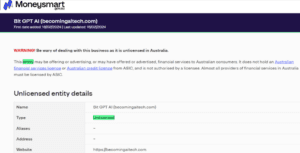
ASIC has highlighted potential risks associated with dealing with this entity. Prospective investors should exercise caution, verify regulatory status, and conduct thorough independent research before engaging with the platform.
Is it really worth to trade with Bit GPT AI?
Recently, there have been several complaints against Bit GPT AI, and many Bit GPT AI customers have reported that their accounts were compromised by Bit GPT AI.
After a thorough analysis of regulations, the nature of business, Bit GPT AI website’s whois details, website content, Bit GPT AI withdrawal policies and other sensitive factors, we have flagged Bit GPT AI. Traders are advised to stay away from such brokers as their funds may be at risk.
If you believe you’ve lost money through Bit GPT AI, you must act fast. Please fill out the form on this page for a free consultation from cyber intelligence specialists who may be able to help you understand your options and trace your assets.
Can Bit GPT AI Be Trusted?
The issue that raises immediate red flags when we analyse a broker is the total lack of registration with any reputable financial regulatory organisation. Legitimate investment platforms are required to be listed with bodies such as the FCA (UK), ASIC (Australia), SEC, or CFTC (United States). These organisations set strict standards, ensuring protection for consumers.
Without this oversight, users of Bit GPT AI have no legal safety net. There is no compensation scheme, no arbitration body, and no authority to hold the platform accountable. In the UK, for instance, only FCA-authorised firms are covered by the Financial Services Compensation Scheme or the Financial Ombudsman Service. In the US, protections offered through FINRA and SIPC are similarly unavailable when dealing with unregistered entities.
This lack of accountability is not accidental — it is often by design.
How Unregulated Online Investment Works?
Platforms like Bit GPT AI typically rely on a series of well-documented deception tactics. Recognizing them is the first step toward protecting yourself.
The Long Con: Relationship-Based
Some of the most damaging issues begin not with a financial pitch, but with a personal connection. Platforms initiate contact through social media, dating apps, or messaging platforms, spending days or weeks cultivating trust before ever mentioning money. By the time an “investment opportunity” is introduced, the victim feels a genuine bond, making skepticism much harder.
The platform they’re directed to is entirely fake, designed to show fabricated profits while quietly holding funds hostage.
Counterfeit Trading Platforms
Victims are shown polished dashboards, realistic price charts, live chat agents, and even early withdrawal wins — all engineered to manufacture credibility. The moment larger sums are deposited, communication often breaks down, and funds become inaccessible.
Warning Signs to Watch For
- Unsolicited Contact — Unexpected messages offering investment tips or opportunities should raise immediate suspicion.
- No Verifiable License — Always check whether a platform is registered with a legitimate financial regulator before depositing anything.
- Guaranteed Returns — No legitimate investment can promise fixed daily profits. This claim alone is a red flag.
- Fabricated Social Proof — Fake testimonials, doctored news coverage, and alleged celebrity endorsements are commonly used to create a false sense of legitimacy.
What to Do If Bit GPT AI Has Taken Your Money?
- Cut Off All Communication — High-risk platforms frequently attempt follow-up schemes disguised as recovery assistance. Do not engage further.
- Alert Your Financial Institution — Contact your bank, card provider, or payment platform immediately to report unauthorized transactions.
- Preserve All Evidence — Save every message, screenshot, transaction record, and email connected to the platform. This documentation is essential for any formal investigation.
- File Official Reports — Submit a complaint to your national cybercrime authority, local law enforcement, and relevant international registries.
Staying vigilant is your best defense. Always verify a platform’s regulatory standing before committing funds, and treat any promise of easy or guaranteed returns as the warning sign it is.
Leave a Reply